This is continuation of Elementary and Middle school maths. Here the topics are advanced. The STAAR question papers can be found for high school in the texas.gov website mentioned in Maths section.

Algebra:

We can move on to algebra 2 section for high school: https://www.mathsisfun.com/algebra/index-2.html

You may want to refresh Algebra 1 section from above website too (see in elementary maths section for details)

Functions:

Functions are a heart of algebra, as anything involving variables is a function. All real life processes are described in terms of functions, and then we solve them.

Khan Academy (Functions and Matrices): https://www.khanacademy.org/math/linear-algebra/matrix-transformations

Though some lessons from above are for Matrices, look at lessons on Functions, transformation, Inverse Functions.

A function is a relation where every domain (x) value maps to only one range (y) value. Strictly function is something that takes a set of values (called as range) and maps it to another set of values (called as range). NOTE: one "x" can have only one "y" and NOT more than one. As an ex: y=f(x)=x^2 always has only one y value for each x value. It's not possible that you plug in x=2 and you end up getting 2 y values. However, 2 x values can map to same y value, i.e both x=2 and x=-2 map to same y=4. So, y=x^2 is a function, but y=sq root(x) is not a function, as x=4 gives two y values, y=2 and y=-2. If we don't consider -ve values of sq root, then sq root becomes a function.

Inverse Function: Very important concept. A function f maps values from x to y. An inverse function [written as f-1(x) ] gets us from y back to x. Consider f(x)=x^2. Inverse function for this would be f-1(x)=√x. Let's choose x=2, then f(2)=4. Now if we apply inverse to 4, we should get 2. g(x)=√x. g(4)=2, So, g is an inverse function, i.e g(x)=f-1(x)=√x. F(x)=x is an identity function, as values remain same on transformation. It's inverse is also same, f-1(x)=x. Any given function has a unique inverse function, i.e it can't have more than one inverse function.

Mathematically f-1(f(x))=x and f(f-1(x))=x

In other way to visualize, functions are deviation from the line y=x, and inverse functions are deviations from that same straight line, but in opposite direction.

Power and Exponential Function:

We looked at power functions (X^2, x^3) etc. Exponential func are 2^x, 3^x, etc. Exponential functions rise even faster than power functions as x appears in the exponent.

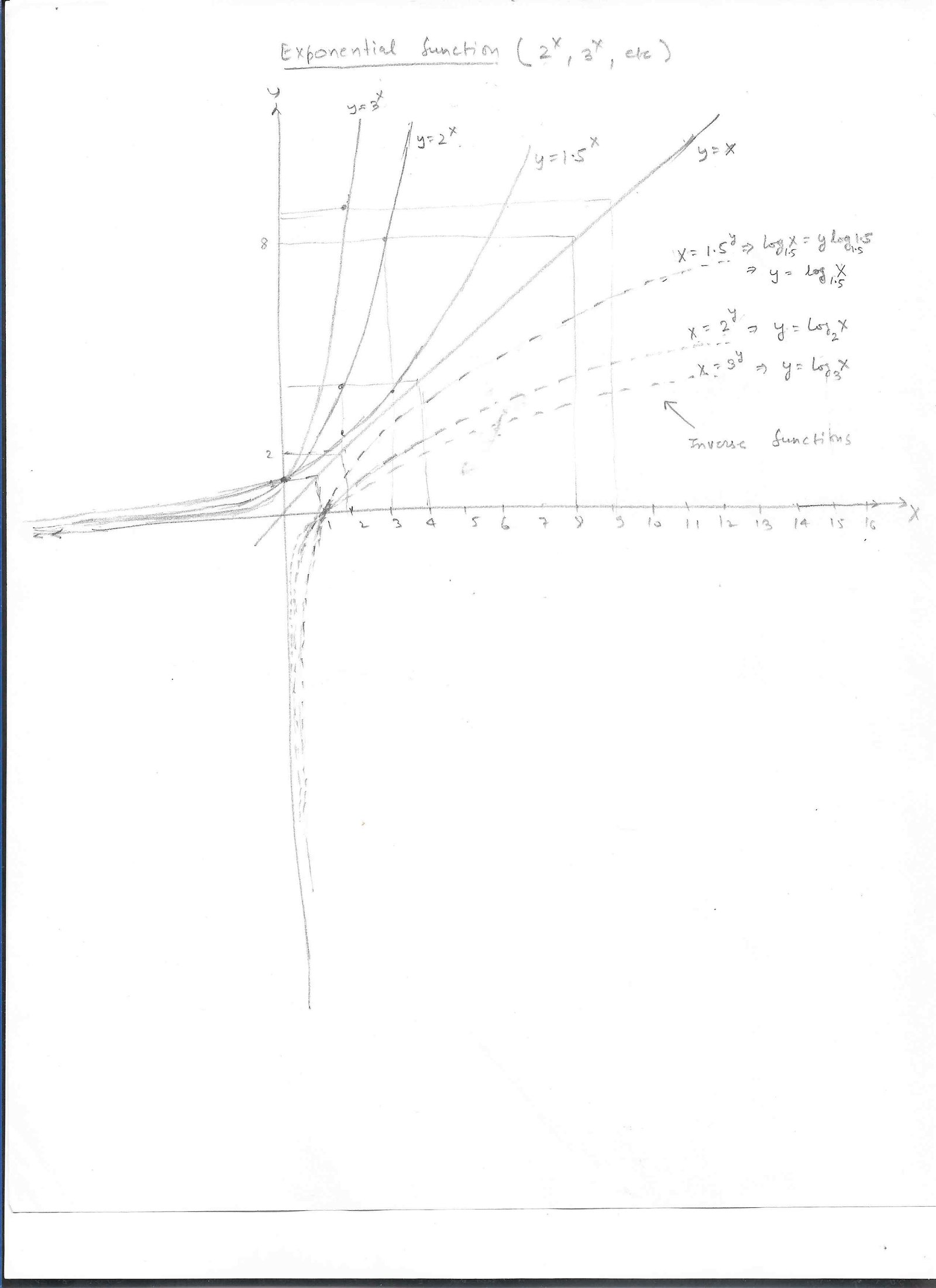
The plot below show the power function and it's inverse (which is sq root), and also exp func and it's inverse (which is log).

  • Given f(x)=x^n, it's inverse is  f-1(x)=x^(1/n).  f-1(f(x))=f-1(x^n) = (x^n)^(1/n)=x^(n*1/n)=x^1=x. Also, doing the other way, f(f-1(x))= f(x^(1/n))=(x^(1/n))^n = x
  • Given f(x)=a^x, it's inverse is  f-1(x)= Logax (where "a" is the base of log). So, other way to look at log func is a^?=x.  f-1(f(x))=f-1(a^x) = a^(Logax) = x.. Also, doing the other way, f(f-1(x))= f(Logax) = a^(Logax)= x

Plot of power function with inverse func:
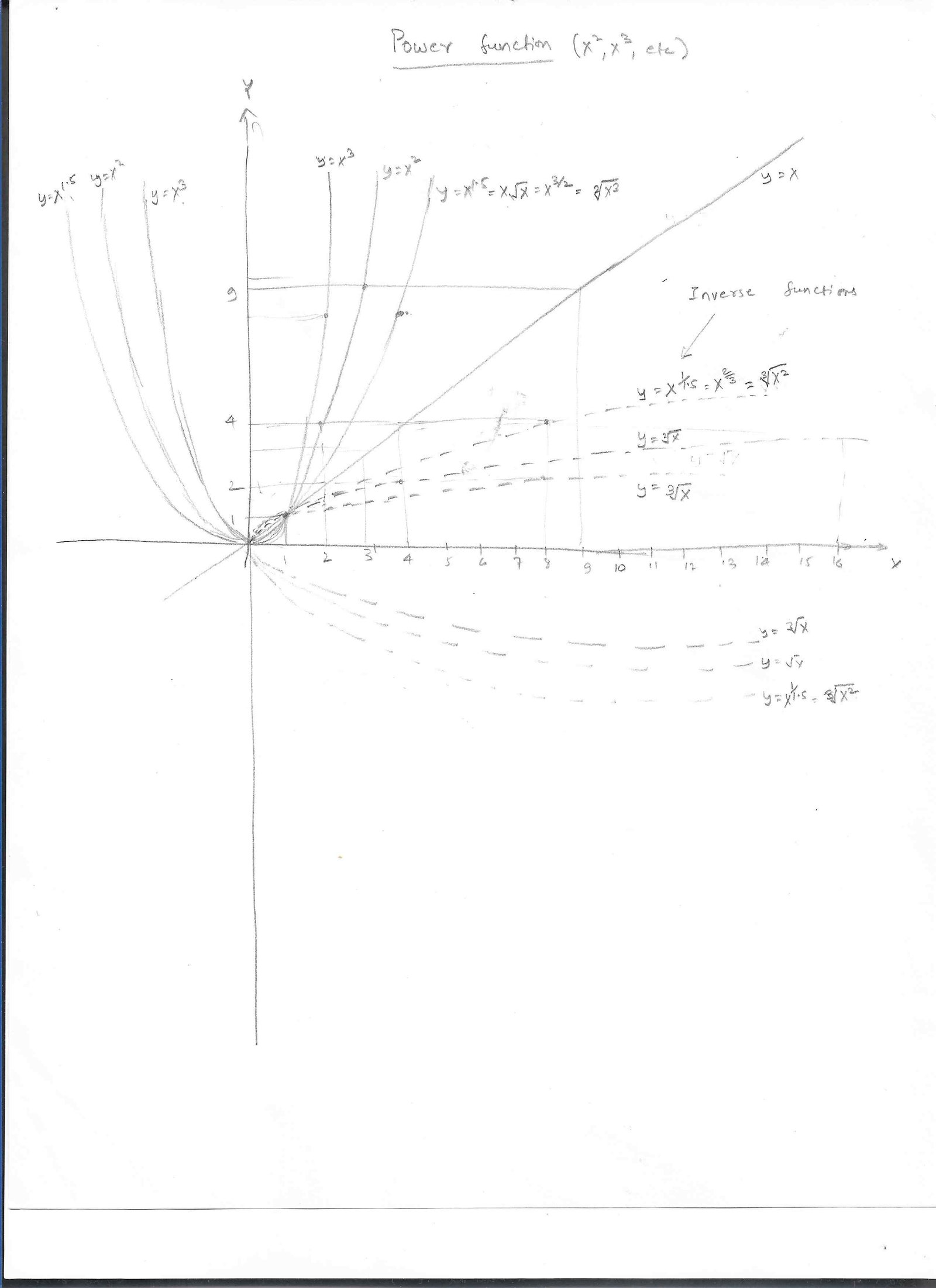
Diagram showing power Func


Plot of exponential function with inverse func:

Diagram showing exponential Func
 

Log properties:

Link (with derivations) => https://www.cuemath.com/algebra/properties-of-logarithms/

NOTE: When base of log func is e, we call it natural log and write it as ln (w/o any base) instead of writing it as loga which is same as writing ln a.

  • logₐ mn = logₐ m + logₐ n (product property)
  • logₐ m/n = logₐ m - logₐ n (quotient property)
  • logₐ mn = n logₐ m (power property)
  • logb a = (loga) / (logb) (change of base property) => Here we can change the log base to any new base "c". 

From above properties, we can get many interesting properties: 

  • alogₐ x = x => This is very important property, that is used in a lot of log problems. This can be proved by taking log of both sides. Basically we are taking inverse of original function, so we get back "x".
  • logbnam= (m/n)*logba. (It's b^n in base of LHS). This can also be proved by writing y=logbnam => y/m=logbna => b^(n*y/m)=a => n*y/m=logb a  => y=(m/n)*logb a which is same as RHS

FIXME: upload hand drawn diagrams.


Polynomials:

We looked at algebraic expressions (i.e xy+2ab+4, etc) in the elementary maths section.

Each of xy, 2ab, 4 is a term. So, there are 3 terms in this expression above.

Terms are separated by +/-. anything  separated by mult or div is not a term. If there is 1 term, it's called a monomial, 2 terms is called binomial, 3 terms is called trinomial, and so on. This whole family of terms is called polynomial. So, monomials are polynomials with only 1 term, binomial are poly with 2 terms and so on. NOTE: terms can only be counted once we have reduced the expression to a sum of product form with no parentheses remaining.

Degree of a poly: The greatest power or exponent of a polynomial is called its degree. So, x.y + a+5 has a degree 2, since it's first term has 1 power from x, and 1 power from y. Note that we add exponents within a term, even though the var are different and they can't be added. The reason we do that is because Degree of a poly refers to how fast the function is exponentially inc or dec. So, even if x and y are diff var, but func itself is moving at the rate of square (i.e if y is made same var as x, then it becomes x^2). Poly with degree of 2 is called Quadratic.

Polynomials are very important class of equations, and almost everything that is modeled in real life is expressed as polynomials. In fact, it has been proved that any complicated shape can be expressed as a polynomial. Each power of x has a constant multiplied with it called as "coefficient"

Addition/Subtraction: Polynomials can be added/subtracted. Only the terms with the same power of x can be reduced by adding/subtracting.

ex: 5x^2 + 2x + 7 + 9x^2+5x+5 = (5x^2+9x^2) + (2x+5x) + (7+5) = 14x^2 + 9x +12

Multiplication: Polynomials can be multiplied, by using the law of exponents explained in elementary maths section.

ex: (9x+5)*(7x^2+3x) = 9x*(7x^2+3) + 5(7x^2+3x) = 63x^3 + 27x + 35x^2 + 15x = 63x^3 + 35x^2 + 42x

Division: Division of polynomials looks tricky, but it can be done using same division method that we use for integer division. We find a multiplicand that can cancel out the term with the highest power of x. Then we move to the next highest power of x, and keep on doing so, until we are done, or left with a remainder.

ex: (2x^2+5x+7) / (x+5) => x+5 | (2x^2+5x+7) | 2x => x+5 | (2x^2+5x+7) | (2x-5) with remainder 32. We can check the answer by multiplying (x+5) and (2x-5). That gives: 2x^2+5x-25. If we add remainder of 32, then we get the original term: (2x^2+5x+7)

Other way to solve this is to divide the numerator in chunks of (x+5). i.e [ 2x(x+5) -5(x+5) +32 ] / (x+5) = 2x(x+5)/(x+5) -5(x+5)/(x+5) +32(x+5) = 2x - 5 + 32/(x+5)

ex: (3x^2+6x)/(x+2) =3x(x+2)/(x+2) = 3x


Plotting of Y vs X:

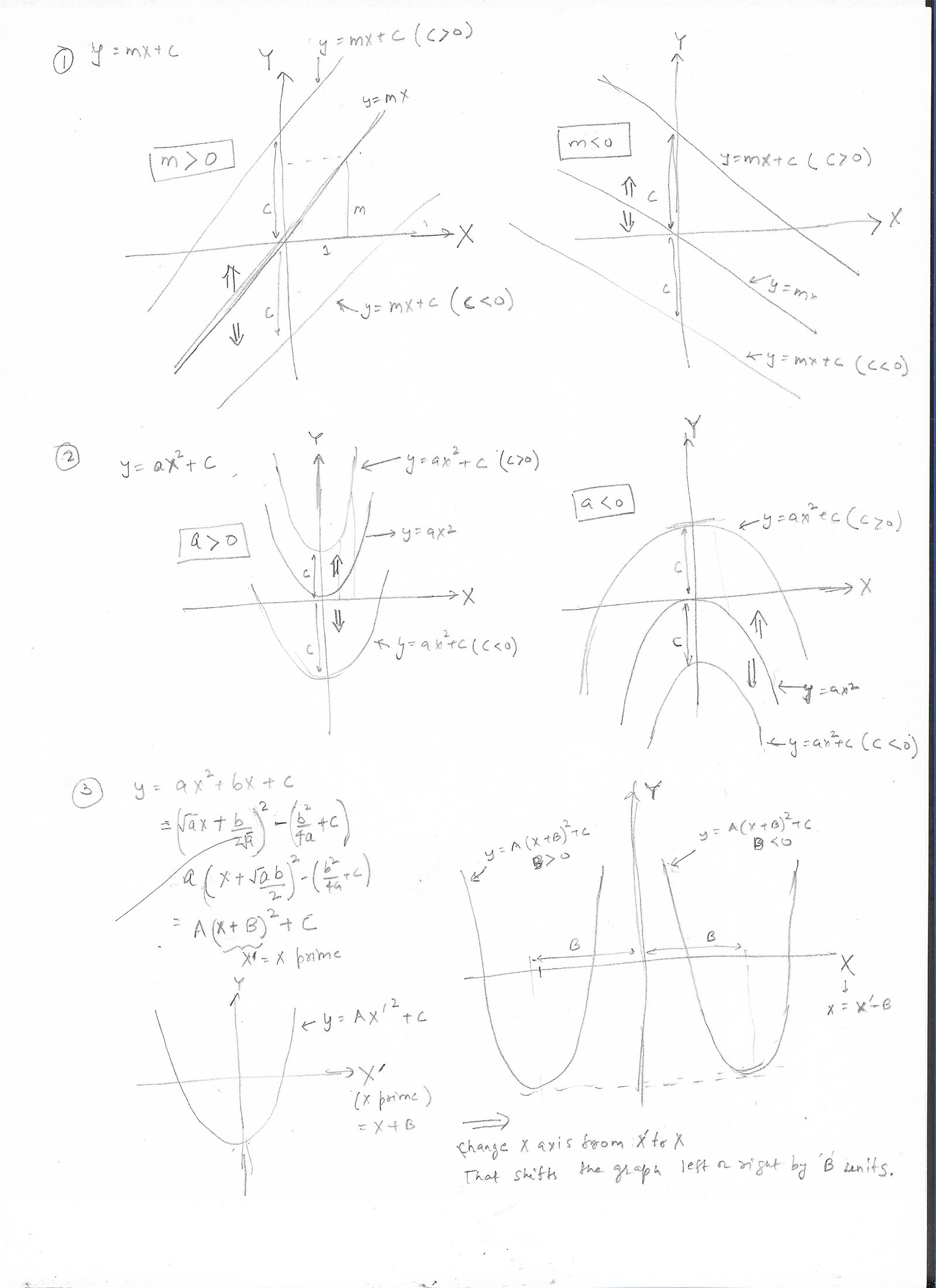
We looked at plotting of eqn of straight line in elementary school maths. High schools expands on that basic knowledge to plot more complicated shapes. We can plot polynomials too, though they are harder to plot. High school limits plotting polynomials to degree=2, which is quadratic equations. We also learn to plot exponential functions here. I've 2 plots below.

Plot 1: This details plotting straight line (linear function) and a curved u shaped line (quadratic function).

Plot of linear and quadratic functions
Plot 2: This details plotting simple exponential functions.
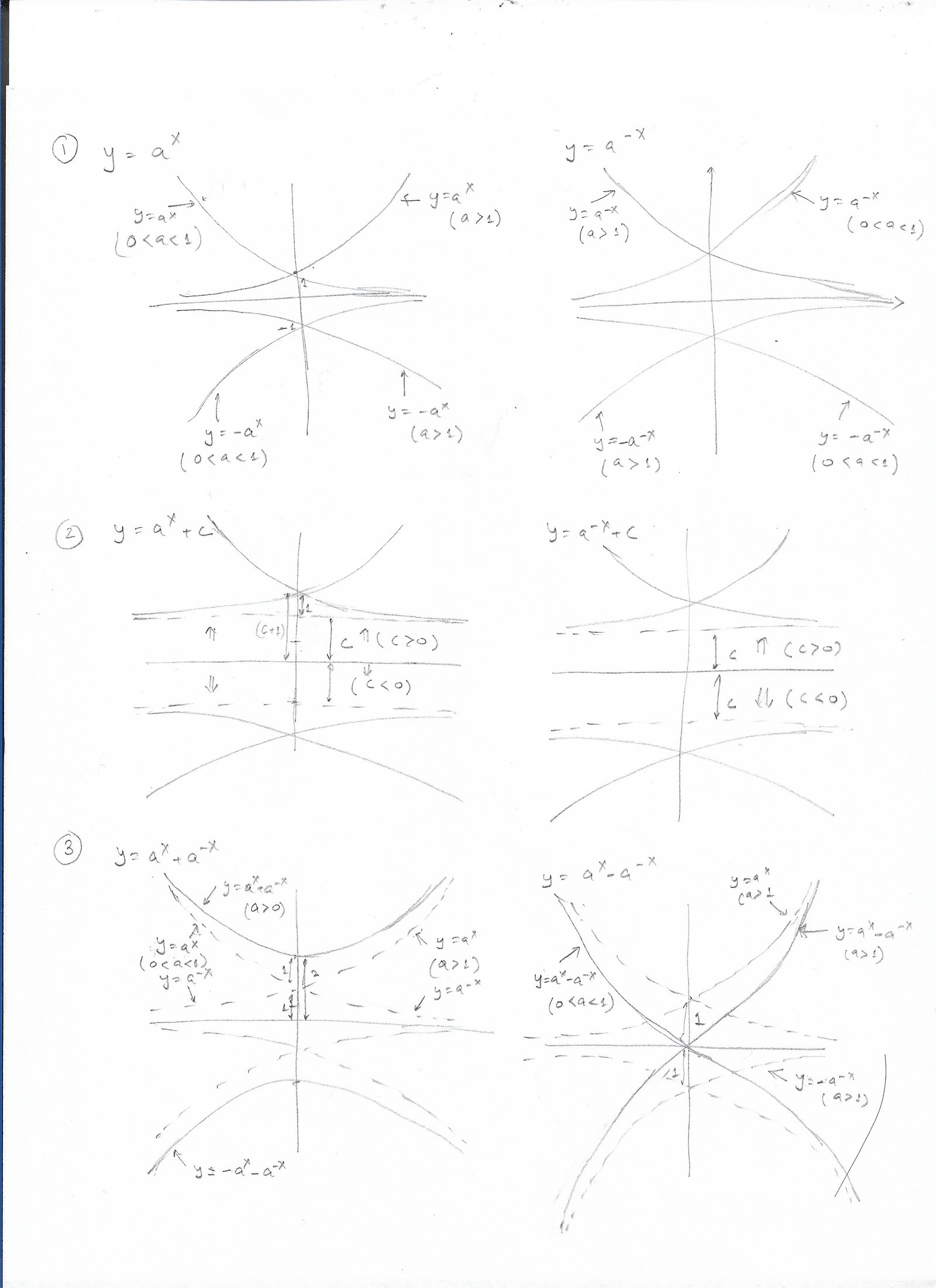
Plot of exponential functions


Algebraic Formula:

There are Formula for algebraic expression that help us in solving more complicated expressions by reducing or expanding them. Some common ones are:

  • (a + b)2 = a2 + 2ab + b2
  • (a – b)2 = a2 – 2ab + b2
  • a2 – b2 = (a – b)(a + b)
  • (a + b)3 = a3 + b3 + 3ab(a + b)
  • (a – b)3 = a3 – b3 – 3ab(a – b) 
  • a3 – b3 = (a – b)(a2 + ab + b2)
  • a3 + b3 = (a + b)(a2 – ab + b2)

Ex: To solve 57^2-43^2 => we can use identity a2 – b2 = (a – b)(a + b) => (57-43)(57+43)=6*100=600. If we try to solve it by taking squares, it will take lot longer.

Ex: To solve 57^2+43^2 => we can use identity  (a + b)2 + (a - b)2 / 2 = (a2 + b2) => ( (57+43)^2 + (57-43)^2 ) /2 = 100^2 + 6^2 / 2 = 100036/2 = 500018

Binomial Theorem:

This is a generalization of (a+b)^n where n is any +ve integer n > 0.

Link: https://en.wikipedia.org/wiki/Binomial_theorem

Theorem was generalized by Newton to allow any real number n. Here (n r) is redefined as falling factorial, since factorial is only defined for integers. It was further generalized to allow complex numbers for x,y.

{\displaystyle (x+y)^{n}=\sum _{k=0}^{n}{n \choose k}x^{n-k}y^{k}=\sum _{k=0}^{n}{n \choose k}x^{k}y^{n-k}.}

Multinomial Theorem: The identity above is generalized to have more than 2 variables, and is called multinomial theorem.The general version (for +ve integer n > 0) is:

{\displaystyle (x_{1}+x_{2}+\cdots +x_{m})^{n}=\sum _{k_{1}+k_{2}+\cdots +k_{m}=n}{\binom {n}{k_{1},k_{2},\ldots ,k_{m}}}x_{1}^{k_{1}}x_{2}^{k_{2}}\cdots x_{m}^{k_{m}},}


Equations:

We looked at solving equations of 1 and 2 variables in the elementary maths section. We looked at linear equations there. Now we look at equations which are not linear in x and y, but have higher powers.

Equations of 1 variable:

Higher powers of x: Here x has higher powers to it. So, it's a polynomial in x. These equations don't have 1 solution for x, but multiple solutions. It has been proved that equation with powers of 2 (i.e x^2) have 2 solutions, x^3 have 3 solutions and so on. It has been proved that polynomial with power n, have n solution, which are called the n roots of the polynomial.

It's the Fundamental theorem of Algebra and applies to coefficients with complex coefficients too:  https://en.wikipedia.org/wiki/Fundamental_theorem_of_algebra

Finding n roots of any polynomial of degree n is not easy, but we know the relation b/w these n roots (roots may be real or imaginary, and may be repeated or unique) via Vieta's Formula: https://en.wikipedia.org/wiki/Vieta%27s_formulas

Complex numbers are explained in advanced Maths section.

We know how to solve x^2, but higher powers of x are harder to solve, and above formulae is used for solving it. Student is not expected to solve those, so we'll just concentrate on x^2 and x^3 (Degree of 2 and 3 are really popular questions in Maths olympiads).

Quadratic Polynomial (Power of 2): ex: x^2 + x = 5. This is called a quadratic equation. This can be solved via 2 ways:

1. Solving by using formula: It can be solved by using the formula for a*x^2 + b*x + c =0.Teach the kid how to derive that formula.

Derivation is not that hard: Look here: https://www.mathsisfun.com/algebra/quadratic-equation-derivation.html

An alternate way to solve is by using the same method as the derivation above. So, solve by making a square in form of (Ax+B)^2 -D + C  = 0. Now bring numbers on RHS, take a square root, and solve for x.

ex: 2x^2+4x - 6 =0 => 2 (X^2 + 2x - 3) =0 => (x+1)^2 - 1 - 3 =0 => (X+1)^2 = 4 => (x+1) = +2,-2 => x=1,-3. So, this is exactly how quadratic eqn solution was derived above.

2. Other way to solve it is to bring it into the form a(x-p1)(x-p2)=0 where p1,p2 are the two solutions (or the 2 roots). There are 2 cases to consider.

  1. When coeff "a" = 1: Then x^2 - (p1+p2)*x + p1*p2 = 0. So, -b/a = the sum of the two roots = p1+p2, while c/a = product of 2 roots = p1*p2. This is a very important property used in factorizing the middle term. When p1,p2 are integers, then it's easier to find 2 such integers that will work. We can't rely on factorizing this if solution involve decimals. NOTE: IF the roots are p1 and p2, then the factors are -p1 and -p2. Since, -p1 + -p2 = b and (-p1)*(-p2)=c, for factorizing, we need to find 2 numbers such that their sum is b and product is c. Then the roots will be negative of those numbers, i.e if the factors are 2,3, then roots will be -2, -3. Important to remember this.
    1. ex: x^2 - 5x + 6 =0 => x^2-3x-2x+6=0 => x(x-3) - 2(x-3) =0 => (x-3)(x-2)=0 => 2 soln for this eqn: x=2 or x=3 (p1+p2=-5, p1*p2=6) => We are looking for 2 numbers whose sum is -5, but whose product is 6. One such pair of numbers is -2,-3. So, we get 2 factors as -2,-3.
  2. When coeff "a" ≠ 1: Above method of factorizing needs to be modified. We can always reduce such eqn to form where a=1 (by dividing whole quad eqn by a"), but then the coeff, b and c may become non integers, which is harder for humans to factorize. If roots are p1, p2, then a*[x^2 - (p1+p2)*x + p1*p2] = 0. Here a*(p1+p2)=-b, and a*p1*p2=c. So, the 2 roots p1, p2 satisfy p1+p2=-b/a and p1*p2=-c/a. What about the factors? Middle coeff "b" needs to separated into 2 terms -a*p1 and -a*p2 s.t (a*p1 + a*p2 = b), and (-(a*p1)*-(a*p2)=a*(a*p1*p2)=a*c). So, 2 factors are such that their sum is b, but their product is a*c. So, the 2 factors are -(a*p1) and -(a*p2), and the roots are p1, p2. Once factors are found, roots can be found by dividing the factors by -a.
    1. ex: 10*x^2-9*x+2=0 => Here we are looking for 2 numbers s.t their sum is -9 and their product is 10*2=20. 2 such numbers are -4 and -5. So factors of middle term are -5x, -4x => 10*x^2 - 5*x - 4*x + 2 =0 => 5*x(2x-1) - 2(2*x-1)=0 => (2*x-1)(5*x-2)=0 => The 2 roots are x=1/2, 2/5. This can also be solved for roots by dividing whole eqn by 10, and then looking for 2 numbers such that p1+p2=-9/10, p1*p2=2/10. One such pair is -4/10, -5/10. But it's much harder to see this as it's in fractions. So, we do it the other way suggested, as that keeps the 2 numbers as integers. The 2 roots can be found from the factors by dividing b -a=-10. So, 2 roots are -4/-10, -5/-10 = 2/5,1/2.

Solving for these eqn the other way round is lot easier. i.e eqn with form (x-2)(x-3) is lot easier to expand than solving eqn of form x^2 - 5x + 6 =0.

Max/Min value of Quadratic Eqn: From the chart and the eqn, we see that any quadratc eqn will always have a max or min value. To find out at what value that happens, we observe that the graph is always symmetric about the 2 roots, p1 and p2, hence the mid point of p1 and p2 is where the max or min occurs. So, x=(p1+p2)/2 is the point where it occurs. Since (p1+p2)=-b/a, so max/min occurs at -b/(2*a). The max/min value here is a(-b/(2a))^2 + b(-b/(2a)) + c =  b^2/4a - b^2/2a + c = -b^2/4a + c = -1/2* [(b^2-4ac)/2a]. Other way to see it is by writing quad eqn in form a(x-h)^2+k. Then max/min occurs at x=h, and max/min value is f(h)=k. Here h=-b/2a and k= -1/2* [(b^2-4ac)/2a].

Cubic Polynomial (Power of 3): ex: x^3 + x^2 + x = 5. This is called a cubic equation. This is harder to solve.

Few ways to solve Cubic Ploy are here => https://en.wikipedia.org/wiki/Cubic_equation

One way to solve is by reducing cubic poly to the form t^3 + p*t+ q = 0 (called as depressed cubic), by change of var x = t - b/(3*a). This simply centers the cubic around the infection pt x=-b/(3*a), which makes it lot easier to solve, by using Cardano's formula or Vieta's formula. The roots for this depressed cubic are given in wiki link above (t0, t1 and t2 roots are expressed in terms of cos and arccos). In Vieta's substitution method, we substitute t=u*cos(θ), and then we get a nice cubic identity in cos(θ), which can be solved.

General way to solve:

For the 3 roots of a*x^3 + b*x^2 + c*x + d =0, p1+p2+p3 = -b/a, p1*p2 + p2*p3 + p1*p3 = c/a, p1*p2*p3 = -d/a.

Putting in the 3 roots => a*(x-p1)*(x-p2)*(x-p3)=0

Again, 2 ways to solve it, as in quadratic formula above. There are 2 cases to consider.

  1. When coeff "a" = 1: This is easy and same as quadratic case. Find 3 integers whose sum is -b, and product is -d. Those will be the roots. One way to solve it by guess, and see if you can get values for p1, p2, p3 (provided p1, p2, p3 are integers). Easy to find all possibilities of such integers, as there aren't too many combo possible.
  2. When coeff "a" ≠ 1: This gets harder. If roots are p1, p2, p3, then a*(x-p1)*(x-p2)*(x-p3)=0 => a*[x^3 - (p1+p2+p3)*x^2 + (...)x + p1*p2*p3] = 0. Here a*(p1+p2+p3)=-b, and a*p1*p2*p3=-d. Middle coeff "b" needs to separated into 3 terms -a*p1, -a*p2 and -a*p3 s.t -(a*p1 + a*p2 + a*p3 = b), and (-a*p1*-a*p2*-a*p3=-a*a*(a*p1*p2*p3)=a*a*d). So, 3 factors are such that their sum is b, but their product is a*a*d (NOTE the a^2 term here instead of 1 term in quadratic eqn). The factors are -a*p1, -a*p2, -a*p3, and then we can get the roots by dividing the factors by -a.
    1. ex: 10*x^3 - 39*x^2 + 29*x - 6 = 0 (AMC 12 Maths Olympiad 2022). => Here we are looking for 3 numbers s.t their sum is -39 and their product is 10*10*-6=-600. Factorizing 600, we get 600=2^3*3*5^2. If we choose 3 factors as -30, -5, -4, then we see that we get  3 such numbers. So, 3 roots are obtained by dividing these factors by -a = 30/10, 5/10 and 4/10 = 3,1/2,2/5.
    2. There is another way to solve the above cubic poly. Expand x^2 coefficient and x coefficient into 2 components and then get 1 root. The other 2 roots will come from the quadratic eqn that we know how to solve. We ignore a for now, and assume a=1. Here we see that sum of these modified roots is 39, while product of these modified roots is 6. So, roots may be 1,1,6 or 2,3,1. We take 1 root as 3, then we break coeff 39 into 2 parts such that 1 factor is 3. If one part is 30, then we get 3 as a root => 10*x^3 - 30*x^2 - 9*x^2 + 27*x + 2*x - 6 =0 => 10*x^2(x-3) -9*x(x-3) + 2(x-3) =0 => (x-3)(10*x^2-9*x+2)=0. So 1 root is 3. The other 2 roots are from quadratic eqn 10*x^2-9*x+2=0, This has been solved above for roots=1/2, 2/5. This method works only because one of the roots happened to be an integer. If all 3 roots were non integers, then this method won't work. It's a quick and dirty visual way to break components into factors.

Radical equation (power of 1/2 or square root, cube root, etc): ex: √(x+2) = 4. These are little tricky to solve. We solve them by converting them to quadratic eqn (for sq root) or to higher powers of x (for cube roots, etc)

One way to solve these is to square or cube both sides of eqn so that sq root, cube root,, etc are gone and we are left with just x, x^2, x^3 or so on, which we know how to solve.

ex: (x+2)^1/2 = 4 => sq both sides => (x+2) = 16 => x=14.

ex: (x+2)^1/2 = -4 => sq both sides => (x+2) = 16 => x=14. Here sq root of a number is set to -ve number. Strictly speaking, x=14 is a solution for this eqn too. However, for sq root eqn, we generally mean the +ve square root solution only. The -ve sq root solution is called extraneous soln, and is generally not considered correct. That's why we should plug in our answer, to see if we get the real soln or not. We need to throw away extraneous soln, and there is no way to know which soln is extraneous w/o plugging in our solved numbers back into the original eqn.

ex: √4 = +2,-2 => This has 2 soln (squaring 2 or -2, both yield 4). However, when we say sq root, we generally mean +ve sq root, so +2 is the real soln, and -2 is extraneous soln which is not considered correct.

NOTE: I'm guessing the reason we don't consider both +ve and -ve soln for √X is because √X won't be a function anymore, i.e for any value of X, we'll have 2 Y, which isn't a function.

Here's a link to solve radical eqn: https://www.mathsisfun.com/algebra/radical-equations-solving.html


Equations of 2 variable:

Higher powers of x and y: Here x and y have higher powers to them. These are even harder to solve, so calculus or computer programs are used to solve it. Depending on powers of x and y, they can have more than 1 solution.

ex: x^2 + y^2 = 13, x^3 + y = 19

Equations of more than 2 variables: Here we have n variables, as x, y, z. We can have linear or higher powers. These are also not expected to be solved by hand, except may be simple linear equation of 3 var  = x, y, z.

ex: x+y+z=34, x+2y+z=38, 2x+y+z=44 => We can solve these 3 equations the same way we solve for 2 equations.


Series:

Arithmetic Series or Arithmetic Progression (AP): This is a series of number where each number differs from the next one by a constant number.

ex: 1, 5, 9, 13, ... => Here the difference between consecutive numbers is 4

finding sum of AP with n numbers, where a=1st number, and d=difference. i.e a, a+d, a+2d, a+3d, ... a+(n-1)d

Sum = a +     (a+d)           + (a+2d) + ....+  (a+(n-1)*d)

Sum = a + (a+(n-1)*d)    +  ....                + (a+d)

=> 2*Sum = 2*a + (2*a+n*d)*(n-1)

=> 2*Sum = 2*a*n + n*d*(n-1)

=> Sum = n*[a + (n-1)*d/2]

ex: For simple AP series of S=1+2+3+...+N => Here a=1, d=1, n=N

=> S=N*[1+(N-1)/2] = N*(N+1)/2

Geometric series or Geometric Progression (GP): This is a series where the ratio between consecutive numbers is constant

ex: 1, 4, 16, 64, ... => Here the ratio between consecutive numbers is 4

finding sum of GP with n numbers, where a=1st number, and r=ratio i.e a, a*r, a*(r^2), a*r^3, ... a*(r^(n-1))

Sum = a +     (a*r)           + (a*r^2) + ....+  (a*r^(n-1))

r.Sum =          (a*r)           + (a*r^2) + ... + (a*r^(n-1)) + (a*r^n)

=> Sum - r.Sum = a - (a*r^n) => NOTE: all other terms cancel out

=> Sum(1-r) = a(1-r^n)

=> Sum = a(1-r^n) / (1-r). For sum of infinite GP, we can solve if the series converges, which happens for |r| < 1. In such a case, r^n goes to 0 as n goes to infinity, which gives Sum = a/(1-r)

ex: For simple GP series of S = 1 + 2 + 4 +8 + ... 2^N => Here a=1, r=2, n=N+1

=> S=1*(1-2^(N+1))/(1-2) = 2^(N+1)-1 => This summation is very useful in Binary number conversion to decimal in computer science

Sum of squares of first n numbers: This is proved by induction to be n(n+1)(2n+1)/6 (see in advanced math section for proof).

W/O induction it's hard. However one can solve it by observing the following via this neat technique.

(n+1)^3 - 1^3 = 3n^3+3n^2+3n

Summation from i=1 to i=N for the expression Σ[(i+1)^3-i^3] will simply be (N+1)^3 - 1^3 as all terms in the series cancel out with each other (since we are subtracting the next number as well as adding the next number). => call it eqn (1)

However, if we simply expand (i+1)^3 into constituent terms, we can also write above expr as  Σ[(i+1)^3-i^3] =  Σi^3 + Σ3*(i^2) + Σ3*i + Σ1 - Σi^3 = 3Σ(i^2) + 3Σi + Σ1 = 3Σ(i^2) + N(N+1)/2 + N => call it eqn (2)

Eqn (1) and (2) are same. So, equating them, we get => (N+1)^3 - 1^3 =  3Σ(i^2) + N(N+1)/2 + N 

=> N^3+3N^2 + 3N = 3Σ(i^2) + N(N+1)/2 + N 

=> 3Σ(i^2) =  N^3+3N^2 + 3N - N^2/2 - 3N/2 

=> 3Σ(i^2) =  N^3+3/2*N^2 + N/2 

=> Σ(i^2) =  1/3*[N^3+3/2*N^2 + N/2] = N/6*(2N^2+3N+1) = N/6*[(N+1)(2N+1)] => which is the same formula as above

Sum of cubes of first n numbers: This is proved by induction to be [n(n+1)/2]^2 (see in advanced math section for proof). It's just square of sum of 1st n numbers, i.e 1^3+2^3=(1+2)^2=9, 1^3+2^3+3^3=(1+2+3)^2=36 and so on ...

To find the formula itself for cubes, we can use the same technique as above. Little longer, but nothing different. However, observing that it's sum of squares is lot easier.

Sum of ith power of first n numbers:There is a general formula involving Bernoulli's numbers and coefficients. Ask ChatGPT for formula.


Simple and Compound Interest:

This is a topic that is introduced in Elementary maths, but I included it here, since compund interest requires solving eqn with higher powers of X.

Simple Interest: Introduce the concept of principal and interest when money is deposited in a bank. Introduce the concept of rate per annum, as well as per quarter, per month, or rate per day. It should be clear that all these rates mean different effective rate.

SI for T years = P*(R/100)*T => Where P=principal, R=rate in % p.a, T=total time in years

Total Principal after T years = P *( 1+R*T/100)

Compound Interest: Compound interest is the compunded interest, where you get interest on the interest too. This seems more fair, since if the bank didn't give you interest on your earned interest, then you scould withdraw that interest, put that interest amount in other bank, and start earning earning interest on that.

CI for 1st year is same as SI for 1st year, if interest rate is per annum

CI (for 1st year) = P*(R/100)

A1 = Total Principal after 1 year = P *( 1+R/100)

CI (for 2nd year) = A1*(R/100)

A2 = Total Principal after 2 years = A1+ A1*R/100 = A1*(1+R/100)

CI (for 3rd year) = A2*(R/100)

A3 = Total Principal after 3 years = A2+ A2*R/100 = A2*(1+R/100) = A1*(1+R/100)^2 = P*(1+R/100)^3

Similarly AT = Total Principal after T years = P*(1+R/100)^T

So, Total Principal after T years = P *( 1+R/100)^T

Conclusion: As can be seen above, CI is more than SI for any year after the 1st year, and total Principal with compound interest is lot more than that with simple interest.


Matrix:

Matrix is one the simple topics, but rather important one to learn. The usage of matrix is not apparent, as it's just a way of representing numbers. Matrices are widely used in computer programming to rep a large set of numbers, and operate on them efficiently.

Good material here: https://www.mathsisfun.com/algebra/matrix-introduction.html

Various operations of +, -, *, / are explained on link above. Most interesting is the multiplication of 2 matrices which is known as the "dot product" of 2 matrices. Most important thing to remember about matrix multiplication is that:

To multiply an m×n matrix by an n×p matrix, the ns must be the same, and the result is an m×p matrix.

i.e (mXn) dot (nXp) = (mXp) matrix

So ... multiplying a 1×3 by a 3×1 gets a 1×1 result. But multiplying a 3×1 by a 1×3 gets a 3×3 result.

NOTE: Terms "Multiplication of 2 matrices" and "Dot product of 2 matrices" are used interchangeably. It's OK to use them with the understanding that multiplication is actually dot product. Multiplication of a matrix with a scalar is simply multiplying each entry of the matrix with that scalar. So, be careful when you see these terms.


Advanced:

Advanced maths topics on Limits, calculus, etc are in next section. I'll start that section in some time. Note that if you are preparing for SAT exam, then everything until is point is all you need. SAT Maths don't need you to know any advanced stuff about calculus, etc. Basic linear and quadratic equation solution, and basic High school maths can easily fetch you 100% score in SAT Maths.


Indian Population and Economy:

In India, there are about 250M households (as of 2011, implying 5 people per household which is 3rd highest in the world), of which 140M households (comprising 700M people) are deprived and earn less than $2K/year. That implies less than $5/day for these poor people to feed a family of 5 (implying feeding on less than $1/day). Next 75M households (comprising 400M people) make between $2K-$5K per year. Again, less than $15/day for whole family to feed. In essence, 80% of the population earns less than $1/hour and feeds on less than a $1/day. As per World Food Programme (WFP), 25% of population is in extreme poverty earning less than $2/day. About 800M are poor, and gap between rich and poor is widening as fast as the economy is growing. Next 30M households is the so called middle class, which comprises of 160M people. They make between $5K - $30K and will definitely be considered poor in any western country. That brings us to top 1% of country who are considered rich. These are 3M households comprising 15M people.

https://desiparinda.files.wordpress.com/2014/08/6a00d8341dd33453ef0147e3b81a02970b.png?w=560

As of 2015, about 4 crore (or 40M) Indians filed Income tax returns of which 2 crore paid taxes (meaning they had an income of over $5K). That implies that about 10% of households paid income taxes (population wise, it's just 3% of population). Total number of crorepaties (people making over $200K/year) was 50K only. In contrast, in USA about 15M people make more than that per year. Total income was 35L crore declared on these income tax returns (approx $0.7T assuming $1=Rs50). Companies filed about 1M returns with gross income of Rs. 11L crore ($0.2T).

http://www.indpaedia.com/ind/index.php/Income_Tax_India:_Statistics


This section deals with Retirement in terms of money and NOT in terms of age.

Retirement refers to Financial freedom. So, why would anyone want to get financial freedom? First of all, you should have the freedom to do anything you want to do, and say NO to things you don't want to do. As I discussed earlier in other articles, most of the people are part of the fake economy, where they get out of their house everyday to dig up a hole for half the day and then fill up that hole for the other half of the day. Why spend your labor doing something that produces nothing? Instead of doing that, you would be better enjoying the life God has given us.

I'll talk about all the strategies that you can use to save enough to achieve financial freedom.

When we talked about GDP, we said that US GDP grows by about 5% a year, and it reflects the total amount of money growth in the system. So, any money you invest anywhere has to grow by 5% every year, just to keep up with the money growth. I think of GDP growth (minus the population growth) as real inflation.

There are 3 places where you can invest in order to grow your savings:

1. Banks: Depositing money in banks is a sure way to lose money every year. With interest rates at 0%, you lose about 5% of your principle amount every year, since GDP grows by 5% a year. So, in 30 years, $1 deposited in bank is reduced to 10 cents when real inflation is considered. Chances are very high that deposit rates may go negative in future (as of 2020, it's still positive). Read in "Banks" section for more details.

2. Bonds: Instead of lending money to banks, you lend it to institutions or private companies. Of course the rate you get here will be higher than what you can get by depositing money in banks, but the money is not insured by FDIC or any other agency. So, if the private company goes bankrupt, almost all of your prinicipal is gone. Read in "Bonds" section for more details.

3. Housing: Housing is one area which has put even "Warren Buffet" to shame. The return that anyone in USA can get in housing is more than what Warren Buffet ever made on any investment in his life. This insane return in housing market (with leveraged money) has been going on for a decade, and with Government supporting housing forever, I don't see how it can burst, unless "FED" is abolished al together. Read in "Housing" section for more details.

4. Stocks: This is my favorite part. This is the mother of all Ponzi schemes and is run by an arm of Govt itself, known as "FED". See in Stocks section on why this Ponzi scheme will run for as long as there is a money printing entity. If this crashes, then housing will crash too, along with all the other assets too. So, if you have to invest in a Ponzi scheme, invest in one that is the mother of all, as it drives all other ponzis. That will be the last one to fail.

Now that we have figured out that stocks are the best investment vehicle for our future returns relative to GDP, let's explore the strategies for retirement in next few sections.


Since English Reading and Writing Comprehensive skills are considered an essential part of US education system, I've added this section to help with that.

From early on, Reading and Writing is encouraged in USA. With new hi tech gadgets, writing is on the decline, and you can see that writing tests are slowly getting omitted from many regular tests. This is really sad, as Reading and Writing are 2 skills that go hand in hand. If you are not able to write a word, you will have to work harder to remember the spelling of that word. Also, writing on a piece of paper with a pencil allows you to make a mental image of your writing. Writing tests have become more like reading tests, where the standardized tests now ask you to figure out if something is written in a correct way or not, instead of you writing it.

Vocabulary: An essential part of reading is to have a good vocabulary. As a kid, we start with very few words (may be 100 or so), but very quickly move on to 1000's of words.

Webster mentions that there are about 1M English words. However, it's complicated to count total words in any language.

  • First the reason is that any language is always expanding, so new words are always getting formed.
  • Secondly, one language gets influenced by other language, and some words from other language start getting used in our language which becomes a gray line.
  • Thirdly, various forms of same word exist, as drive, drove, drives, etc, OR one word with multiple different meanings exist, which may be counted as separate words or as 1 word, depending on one's taste.

There is a very a good article here on how many words different languages have and how many do you need to learn: https://www.lingholic.com/how-many-words-do-i-need-to-know/

As per above article, English has 171,476 words in current use, 47,156 obsolete words and 615,100 definitions. You will find the reference of 100K word families in English language mentioned elsewhere too. A native English speaking person knows between 10,000 (uneducated) to 20,000 (educated) word families.

In part 2 of the series, the author says that the average active vocabulary of an adult English speaker is of around 20,000 words, with a passive one of around 40,000 words. Active vocabulary is one that you use, while passive vocabulary is one that you recognize but don't use. Further he states that the first 25 words are used in 33% of everyday writing, the first 100 words appear in 50% of adult and student writing, and the first 1,000 words are used in 89% of every day writing! Of course, as we progressively move to a higher percentage, the number of words starts to dramatically increase (especially after 95% of comprehension), but it has been said that a vocabulary of just 3000 words provides coverage for around 95% of common texts (such as news items, blogs, etc.). We want to know these 10K-20K words from active vocabulary, that are used in spoken and written English, though not commonly.

If you learn even 1 new word a day, you will learn about 3K new words in a span of 10 years. I remember when I prepared for my GRE, I had this GRE prep book that had 3K words. I was told by experts that if I learnt these 3K words, I would be able to answer all vocabulary questions. I was surprised, since English language had so many more words, so how would just knowing 3K more words help. Now I  know, how extra 3K words can add so much to your vocabulary !!

CEFR (Common European Framework of Reference) is a description of the language abilities of students at different levels of learning. A is lower level, B is intermediate level, while C is advanced level.

  • A1/A2 level: It's beginners level. At A2 level, you have a vocabulary of about 1500 words. It takes about 200 hours of studying english to reach this level. You can talk with english speakers and read simple texts at this level.
  • B1/B2 level. It's intermediate level. At B2 level, you have a vocabulary of about 4000 words. It takes about 600 hours of studying english to reach this level. You can talk fluently with other English speakers on any complex topic. You can live and work in any english speaking country. You have confidence and control when speaking, writing, and reading.
  • C1/C2 level: It's advanced level. At C1 level, you have a vocabulary of about 8000 words. It takes about 800 hours of studying english to reach this level. C2 is the mastery level, and you have a vocabulary of about 16000 words at this level. you talk, read and write just as a native speaker of the language.

This is just the start, where you start having mastery similar to native speaker of the language. This is where we want our vocabulary to be. To have your vocabulary at a level where you can read newspapers, magazines, etc without trying to guess meanings of words, you need to be at C2 level These are the words that are not that common in day to day speech, but used frequently in media papers, journals, etc

As an example, vocabulary.com lists these 100 words that are expected of a high school Freshman (basically 9th grade sudent) to know.

https://www.vocabulary.com/lists/79298

or high school vocabulary test here:

https://www.buzzfeed.com/angelospagnolo/can-you-pass-this-high-school-vocab-quiz

If you know all the words above, then you have vocabulary at C2 level. We want to get to a level of English speaking high school graduate.

I've a section titled "Word of the Day" that will aid us in our vocabulary quest.

http://maaldaar.com/index.php/word-of-the-day

Reading:

We need to develop our comprehending and reading skill This comes with reading a lot of different kinds of subjects.

One good starting point is some good articles here:

https://linguapress.com/advanced.htm


Best Checking accounts:

Usually checking accounts give lower interest rate than savings account. However, there is new kind of checking accounts known as Kasasa Accounts. These Kasasa accouunts can be Checking or Savings, but are usually checking accounts.More details here:

Enter your zip code to see banks/CU giving you the highest rates => https://www.kasasa.com/

List of all Banks/CU offering Kasasa accounts is on this link: https://www.depositaccounts.com/kasasa/

However these accounts come with a lot of catch. They require you to do multiple things each month in order to get higher rates, and then they cap you on the max interest that you can earn every year. Each Kasasa Account is different but most of them require you to do these few activities each month

  • Do at least 10-15 debit card transactions every month. Sometimes, they also put a minimum dollar limit (i.e each transaction should be over $5) in order to be counted towards these 10-15 qualifying transactions
  • Do at least 1 direct deposit to the account or have an ACH transaction into or out of the account every month. ACH requirement is easy as you can set up automatic ACH from any bank every month. DD requirement is harder, but most of the banks allow either of these.
  • Receive electronic statements every month. There is nothing to do here, as there are no paper statements to be delivered anyway. Just sign up for edocuments if there's an option to do that.
  • The Maximum interest that you can earn is limited to a certain amount, i.e you will get 3% interest on only the first $10K, $25K or something like this. So, any balance that you have over that amount earns the lower interest rate, which is usally < 0.5%
  • And now the nastiest requirement - this is new. Since last year or so, These accounts have started putting in a language that "your debit card usage should show regular day to day purchases" and NOT purchases which are made solely with the aim of earning higher interest rate. This allows these banks to NOT honor your higher rate at their discretion, even though you might have met all the requirements. If this happens to you anytime, just move your money to a different bank, and repeat the process. Not worth arguing.
  • And now the worst part - these kasasa have been historically known to offer high interest rates for a year, and then they drop the interest rate to market rate. So, these accounts are solely used for the purpose of sucking in new customers, and then hoping that 80% of them still remain with the bank, even with the lower interest rate. Seems it works for these banks. But for us, we need to be prepared to move on to greener pastures and NOT be suckers for them..
  • And now the surprising good part - Many of these Kasasa Checking Account, also allow you to open a Kasasa Savings account. These Savings account give you high rate on money in Savings account with a much larger threshold, so definitely worth it. As long as you meet monthly qualifications for Kasasa Checking account, you get the higher interest rate in Kasasa Savings account too. There are no separate requirements for qualifying for higher rate for a Kasasa Savings account.

I've recommended them in past, because savings account and CD had rates below 1%, and these checking accounts were the only ones that offered you over 2% in interest rates. The difference between highest interest savings accounts and Kasasa accounts have to be at least 1%, and max amount has to be $50K or more in order for the Kasasa accounts to be worth the headache. With 1% difference on $50K, you will earn about $500 more in interest in Kasasa accounts.

In a normal interest rate environment, that existed before 2008, you would not open these checking accounts as their rates were very close to what you could get in a savings account. So before 2008, these accounts were not worth it. From 2008 to 2017, interest rates were close to 0%, and these checking accounts started making sense. However, FED started increasing interest rates in 2017. From 2018 to 2019, rates went to > 2% on regular savings accounts, so these high yield checking accounts were again not worth it. However starting 2020, FED dropped interest rates agian to 0% and declared that low interest rates are here to stay (meaning no interest rate increases ever as far as you can see, which was obvious any way). So, savings account are all under 1% now, while kasasa checking accounts can get you 2%. So, better to put short term money in these checking account, instead of savings account, before you can accumulate enough to park in a CD. Anyway, if you have accumulated enough to park in a CD, then you should just put them in an index fund in stock market.

I'll mostly be listing Kasasa Checking accounts below, as it's impossible to find Non-Kasasa Checking or savings account that can offer you these high rates. Except for one wink


2023-2025:


  •  Andrews FCU (Nationwide with 5.5% rates on < $25K): https://www.andrewsfcu.org/Bank/Spending/Personal-Checking/Kasasa-Cash-Checking
    • 2025: In Aug 2025, this bank had deposit rates of 5.5% on their Kasasa Personal checking a/c. I couldn't find historical rates for them. Membership is open to anyone through the American Consumer Council. Requirements are as below:
      • 15 debit transactions (No minimum for each transaction), enroll in estatements and have 1 ACH/DD transaction every month
      • Their Kasasa Personal Savings a/c also gives high interest of 2% on up to $100K with no separate requirements. You automatically qualify for higher rates in this a/c if you qualify for higher rates in checking a/c.
    • Bonus of $150 for opening the above Kasasa checking a/c => https://www.andrewsfcu.org/new150


  •  Signature FCU (Nationwide with 5% rates on < $25K): https://www.signaturefcu.org/Products/Accounts/Checking.aspx 
    • 2025: On 11 Aug 2025, this bank raised deposit rates of 5% on their Kasasa Personal checking a/c. Rates had been lower at 3.5% before that. Membership is open to everyone. Their requirement has at least 1 DD of > $500 every month (ACH doesn't count, so it's a tough requirement to meet. Most of the other Kasasa banks have either ACH or DD as requirement). So, not recommended as there are better option elsewhere. I'm listing it in case you run out of options. Requirements are as below:
      • 15 debit transactions (No minimum for each transaction), enroll in estatements and have atleast 1 DD of > $500 (NO ACH) every month


  •  Keystone Bank (TX only with 6% rates on < $50K): https://www.keystone.bank/for-you/personal-checking
    • 2023: In May 2023, this bank raised deposit rates on their Kasasa Personal checking a/c from 1.5% to 6%, which was the highest of any bank at that time. Before 2023, it was available only for residents living around Austin, but in May 2023 they expanded it to 65 counties in Texas (Texas has 254 counties, so not all of Texas). Requirements are as below:
      • 12 debit transactions ($3.50 minimum for each transaction), enroll in estatements and have 1 ACH transaction every month
      • Their Kasasa Personal Savings a/c also gives high interest of 4.5% on up to $100K with no separate requirements. You automatically qualify for higher rates in this a/c if you qualify for higher rates in checking a/c.
    • UPDATE (Nov, 2024): Their rate is at 5.5% for the checking a/c and 4.75% for the savings a/c. Still the highest amongst all Kasasa banks, and their rates have barely moved down in last 1 1/2 years. So, worth having this a/c if you live in Texas (looks like they cover all of TX, but not sure. Try your zipcode to check).


  •  Keesler Federal Credit Union (UPDATE): https://www.kfcu.org/rates/
    • UPDATE (May, 2023): This bank listed below (in year "2020" section), recently upped their checking rate to 5% from 3%. One of the best banks to have. Their rates had been consistently at 3% for past 4 years, even when other banks wer doing "bait and switch", so very reliable. If you qualify to join, you should definitely look in this. Link: https://www.kfcu.org/kasasa-cash-checking/
    • UPDATE (2024): The checking a/c doesn't seem to be linked to Kasasa anymore as the Kasasa link and reference isn't there anymore on kfcu site. So, it isn't Kasasa checking a/c anymore. However, the checking a/c still offers 5% rate, so all is still good.


  • Union Square (UPDATE): https://www.unionsquare.org/kasasa-cash
    • UPDATE (June, 2023): This bank listed below (in year "2022" section), recently upped their checking rate to 6% from 4% on the first $35K in deposit. 6% is the highest rate offered by any bank/CU or any short term CD, so you should definitely jump on this one. Next tier is also upped from 0.75% to 1.5%.
    • UPDATE (Mar, 2024): They reduced their checking rate from 6% to 4% on the first $25K (NOT $35K) in deposit. Next tier is also reduced from 1.5% to 0.75%. So, they aren't reliable as their rates change with market.
    • UPDATE (Feb, 2025): They reduced their checking rate again from 4% to 3.5% on the first $25K in deposit. Next tier is also reduced from 0.75% to 0.5%. So, rates are back to 2021 rates. It shouldn't go further down from here, as they had these rates in 2019 - 2021 even when fed rates were close to 0%.


2022:


  • Presidential Bank (Nationwide with high rates on < $25K):  https://www.presidential.com/Personal-Banking/Checking-Savings/Checking
    • This is their Advantage Checking account that gives the high rates. Need to have a direct deposit of $500 or more from payroll, pension, social security, or annuity.  Each account must have a unique direct deposit source.  At least seven (7) electronic withdrawals per month are required (electronic withdrawals include: ATM, POS, ACH and Bill Payments). Requirements look pretty easy for electronic withdrawals as you may set up a recurring ACH of 2 times/week initiated from another bank. To be on the safe side, I would do ACH from 2 different banks of 2 times/week, for a total of 16 ACH withdrawals. That way if something goes wrong with ACH of one bank, you are still covered. More details on link above.
    • The max amount that earns the high rate of 3% is limited to first $25K, but even above $25K earns you a high rate of 2.5%. I guess balances up to $250K would give you 2.5% interest rate which is unheard of in checking accounts. Above link gives old rate, but new rates are posted here (as of Sept, 2022): https://www.presidential.com/personal-banking/checking-savings/rates-yields#advantage-checking
    • It's open nationwide. Based on the comments, the rate has been fluctuating since 2010, so not very reliable bank as far as rates are concerned. DepositAccounts site doesn't have any history of rates. 1 comment says rates were 2.25% in 2020. Link: https://www.depositaccounts.com/banks/presidential-bank-md.html#rates
    • They offer free check book when you open the account, along with ability to write 3 paper checks for free every month. This is also very rare among kasasa checking accounts.
    • Minimum balance of $500 is required, or else you get hit with monthly fees. So, always keep $1000's of dollars to be safe. They don't refund fees based on comments.
    • I would definitely consider this account, as requirements are simple except for Direct Deposit. Not sure if any of the ACH from brokerage accounts or big banks get counted as Direct Deposit. I would just do a real direct deposit so as to be safe.


  • Origin Bank (Texas only with high rates on < $40K): https://www.origin.bank/ . This bank is listed below for 2019, when they offered their Kasasa Account. It Closed for new accounts as of Sept, 2020, but now in 2022 it is accepting new customers. 
    • 4% APY on $40K with 16 debit card transactions. No direct deposit but 1 ACH required. Requirement must be completed 3 days prior to end of statement cycle, else you get 0% interest.
    • However, only open for residents of Texas, Mississippi and Louisiana. Also, no rates guaranteed (last time they guaranteed until June, 2020).
    • Account can only be opened in branch, and their branches are only in few big cities in these 3 states. So, not worth it, if you don't live close to their branches.
    • Need to keep a minimum of $4K avg daily balance every statement cycle, else you get hit with $14 service charge for that month.
    • Discussion here: https://www.doctorofcredit.com/tx-ms-la-origin-bank-performance-checking-4-apy-on-balances-up-to-40000-direct-deposit-not-required/
    • I would stay away, as they have a history of lowering rates, after getting enough customers.
    • UPDATE Nov 14, 2022: Rates have been increased to 6% on $40K. Rates not guaranteed this time too. All other requirements are the same. Worth the chase, though comments indicate it's a hassle.


2021:


  • Affiliated Bank (UPDATE): https://www.affiliatedbank.com/personal/accounts/checking/kasasa-cash/
    • UPDATE (Nov, 2021): This bank listed below (in year "2020" section), recently lowered their checking rate to 1.5% from 2%. So, now you make extra 0.5% on $50K, compared to Tmobile account. This extra 0.5% amounts to $250 per year. Paying taxes of 24% on it, you will net $180. But to get this $180, you have to make monthly purchase of at least $5*12=$60. So, yearly you have to spend about $800 to get $180. Not worth it, as you can easily get 5% for grocery purchases, so net difference goes down to $120 for a year, or $10 a month. Doing 12 debit card transactions per month takes about half an hour, so you are making $20/hr for your effort every month. So not worth it to keep any money in this account anymore, as T-mobile checking gives 1% on all of your balance without doing anything.
    • https://www.depositaccounts.com/banks/susser-bank.html


  • Union Square (Texas and Oklahoma only with high rates on < $25K): https://www.unionsquare.org/kasasa-cash
    • I just came to know about their Kasasa Checking via a comment on doctorofcredit. Link: https://www.doctorofcredit.com/tx-ok-union-square-credit-union-3-51-apy-on-balances-up-to-25000/
    • It's open to anyone living in Texas and Oklahoma. Texas residents who join either the Texas Consumer Council or the American Red Cross-North Texas Region are eligible to join, as are Oklahoma residents who join the American Red Cross-Oklahoma Region. Even though they mention TX and OK only as membership requirement, it appears to be national (i.e anyone in USA may join). There are comments on link below that suggest people from other states have opened without any issues (once they joined one of the orgs listed above):
    • Offer details: 3.5% on upto $25K (nets about $900/year. Their rate has been consistent for last 2 years. See in rate history here: https://www.depositaccounts.com/banks/union-square-cu.html
    • Requirements are: Make at least 12 debit card transactions every month (no min balance), Make at least 1 DD or ACH transaction every month and get estatements.
      • CAUTION: Their requirements of 12debit card transaction is very stringent. They want your debit card to be used as the primary card for purchasing anything. They clearly mention that debit card purchases have to be of different amounts, done during different times, should be all over the place, etc. Basically, they can deny you 3.5% interest rate anytime at their will. If they have someone manually reviewing the account every month, then most likely you won't get it. I'll give this account a try and report back.
      • UPDATE Oct, 2022: After having this account for a year, and making 12-15 debit card transactions each month, with each transaction being from $1-$3, I haven't seen any issue. I get 3.5% interest every month,  and no one from the bank has ever called me or sent any letter for anything. So, looks like it's not really that stringent in practice, and should be an easy account to maintain. Just don't test the bank by pushing yourself to the limits.
    • They have a kasasa savings account that goes with it. That pays only 0.75% and that too only on top $25K. So, don't bother with this one, as you can get 1% with t-mobile account.


2020:


  • TMobile Money (Nationwide with high rates on < $3K): https://www.t-mobilemoney.com/en/home.html
    • I've never bothered with T-mobile money in past, since you got 3% anyway with Kasasa accouts, so opening 1 more account for $30 more per year wasn't worth the trouble. However, with FED announcing sub 0% rates for as long as FED is alive (i.e infinity), it finally may make sense.
    • Reviews are pretty good, since T-mobile is a great company with superior customer service, known for cheapest plans in USA. signup is easy. They allow 1 account every phone line. You need to create Tmobile Id using your email address, and then later link your phone number with this account. You get a debit card, and there is no fees for this account.
    • They give 4% on 1st $3K and 1% on any amount over $3K. They are open to non Tmobile customers also, however non Tmobile customers get only 1% on all of the amount (instead of the higher 4% on the 1st $3K). This account has been there for almost 2 years, and the rates have remained the same, so most likely rates will remain at this rate.
    • These are the requirements to get 4% APY (you get 1% by default if you don't meet these requirements):
      • You need to do at least $200 in direct deposit or ACH transaction every month in order to get the higher 4% rate. It seems like a hassle to do $200 DD/ACH per month. However, ACH is easy. Just set it as automatic monthly deposit and withdrawal of $200, so that you always keep the account at $3K. You can do this ACH auto setup easily from any other bank account. Set it as $200 deposit/withdrawal every 2 weeks, so that even if you miss one of the deposit/withdrawal for whatever reason, you can still get the 4% APY. I've run into issues where due to some software update at a particular bank, they cancelled the ACH for that week. So, the bank it was supposed to go to didn't get it, and hence I didn't qualify for the rewards for that month. Setting it up as 2 or 3 times a month guarantees you that no matter what, at least one of the ACH will go thru.
      • UPDATE: 21/02/2021: The unthinkable happened. T-mobile has changed the terms where they now require you to make 10 debit card purchases every month in order to get 4% APY. You don't need to make $200 deposits any more. All other terms remain the same. So, this is a downgrade from what they had earlier. Unless you can find an online way of automatically doing 10 transactions every month, it may not be worth it chasing that extra $50/year for doing 120 transactions. More details here: https://www.doctorofcredit.com/t-mobile-money-review-earn-4-apy-on-balances-up-to-3000/
      • You need to register for Tmobile perks. After you signup, there is a tab "My perks" on top. Click on it.It will ask for your phone number to link to your account. Once verified, it will ask to register for perks, and show successful confirmation. At this point, you'll see "manage perks". So, you are registered for perks at this time.
    • Do not put too much money in the account (keep it under $10K, ideally just keep $3K), as it has a monthly withdrawal limit of $10K, so it may take a while to get all of your money out (this is based on comments in Dr of credit website: https://www.doctorofcredit.com/t-mobile-money-review-earn-4-apy-on-balances-up-to-3000/). There is nothing mentioned officially about withdrawal limits.
    • Tmobile Money itself is not a bank, The accounts at Tmobile money are held at BankMobile, which is itself a division of "Customer's Bank". Customer's Bank is FDIC insured bank (FDIC certificate number is 34444). You can find details here on fdic.gov:
      • https://research2.fdic.gov/bankfind/detail.html?bank=34444&name=http%3A%2F%2Fwww.customersbank.com&searchName=&searchFdic=34444&city=&state=&zip=&address=&searchWithin=&activeFlag=&searchByTradename=false&tabId=2
      • FY 2019 summary for Customers Bank: It had $9B in deposits at end of 2019. It had about $7.3B in interest bearing accounts (Are interest bearing accounts mostly Tmobile money accounts?). It had $200M in interest expense (implying $0.2B/$7.3B = 3% in interest rate, which matches close to Tmobile's checking account rate of 1%-4%). It had $500M in interest income, resulting in $300M in net interest income. After accounting for all expenses, it's net income was $80M for 2019.
      • FY 2020: For 2020, results look more impressive. As of Mid year, 2020, it had interest bearing deposits of $9B, implying deposits going up significantly. This may be because Tmobile's 1% rate is higher than any bank of it's size. Pretty soon, Tmobile may be the only bank offering 1% interest across any sized bank in USA.
      • UPDATE 2021: Tmobile is the only bank offering 1% interest rate across any bank in USA (based on Doctorofcredit website). Enjoy your extra $20/year income with hefty 1% APY.
      • Customers bank is big size bank, as it's at #130 in terms of asset size across all 5000 banks in USA. Since Customers Bank is big yet profitable with such a high interest expense, chances are high that it may be able to maintain this 4% APY on $3K (and 1% APY on over $3K) for at least some time. 


  • SSB Bank (Nationwide with high rates on < $50K): https://www.ssbpgh.com/cash 
    • They don't allow online application. Talked to Brian in customer service, and as of Sept, 2020, you need to be able to go to their branch in Pennsylvania in order to open the account. Anyone living in any state in USA is eligible though. Sometime next year, they may allow online application, and then we all might be able to get in, provided the rates are still good at that time.
    • Kasasa Cash Checking Account Rate is 2.25% on up to $25K with 12 debit card transaction ($5 mimimum per purchase), and 1 direct deposit or 1 ACH transaction, with online statements. 
    • SSB also has "Kasasa Savers" account which gives you 1.5% interest on up to $100K as long as you meet their Kasasa Checking account requirements. i.e there is no separate requirement for Kasasa Savings account.


  • First Security Bank (Nationwide with high rates on < $50K): https://www.1stsecuritybank.com/personal/checking/kasasa_cash/
    • Kasasa Cash Checking Account Rate is 2.01% on up to $50K with 18 debit card transaction (No mimimum per purchase), and 1 direct deposit or 1 ACH transaction, with online statements. 
    • It also has "Kasasa Savers" account which gives you 1.31% interest on up to $50K as long as you meet their Kasasa Checking account requirements. i.e there is no separate requirement for Kasasa Savings account.
    • UPDATE: Sept, 2022: Rates For FSB have fallen back to 0.8% and that also is valid on a very small amount of $15K only. So, this bank is a "bait and switch" bank. So, no reason to join ever.


  •  Keesler Federal Credit Union (Limited counties in Mississippi, Louisiana and Alabama only with high rates on < $25K): https://www.kfcu.org/rates/
    • Generally, a  bank or credit union doesn't give you the best rate for all their products, but Keesler is an exception. I've been watching them for 2 years now, and their rates are the best across savings account, checking account and CD. Also, they are more consistent with their rates, and don't drop their rates that frequently. In fact, their rate of > 3% on CD was there for couple of months more, even after FED dropped their rates multiple times in 2019. I asked them multiple times if their 3% CD rates were promotional rates and if the offer was going to end soon, and they always indicated that their rates are not promotional, and stay there for a long time (which turned out to be true).
    • One downside with Keesler is that they do a hard pull on your credit report, no matter what kind of account you open with them. I don't support any bank with hard pull, but with their consistently high rates, it may be worth it.
    • Other downside is that they are not open to everyone. They used to be open to everyone nationwide, but recently (in 2020) they limited their membership to people living in certain counties. However, people who joined before this change will remain their member irrespective of new requirements. They have a note on their website asking to email them to find out other ways to qualify. You can always call and ask them to see if you can become a member. I guess they added this requirement since they might have gotten too much money in deposits. Now they might be selectively taking people from other states.
    • Keesler has Kasasa Checking account which pays you 3% interest rate on up to $25K with 12 debit card transaction (no minimum per purchase), and 1 direct deposit or 1 ACH transaction, with online statements. For ACH transaction, just set it up as a recurring transfer every 2 weeks with some other bank and then forget it. I recommend 2 times a month since in case the transaction doesn't go thru for any reason, you can look at it in time, and fix it. Other transaction serves as a backup.
    • Keesler also has "Kasasa Saver Qualified" account which gives you 1% interest on up to $150K as long as you meet their Kasasa Checking account requirements. i.e there is no separate requirement for Kasasa Savings account.


  •  Affiliated Bank (Texas only with high rates on < $50K): https://www.affiliatedbank.com/personal/accounts/checking/kasasa-cash/
    • This offer is open for residents of Texas only. They is a kasasa checking account. They offered the "Kasasa Cash" checking account in 2019. At that time, they offered 4% on $50K, with 12 debit card transaction (no mimimum per purchase), and 1 direct deposit or 1 ACH transaction, with online statements. However, early 2020, they changed it to 0.75% on $50K with 12 debit card transaction (with $5 mimimum per purchase), Then in July 2020, they upped the interest rate to 2% on $50K with same requirements. So, proceed with caution as I have no idea of when they might lower their rates (as history isn't in their favor).
    • You also need to make 1 direct deposit or 1 ACH transaction (incoming or outgoing, doesn't matter) per statement cycle. Just set it up as a recurring transfer every 2 weeks with some other bank and then forget it. I recommend 2 times a month since in case the transaction doesn't go thru for any reason, you can look at it in time, and fix it.  You also need to sign up for e-statements (no paper copies).
    • They are offering Kasasa Cash savings account also in which they offer 1% for upto $200K, as long as you meet their Kasasa Checking account requirements. i.e there is no separate requirement for Kasasa Savings account.


2019: